|
A massacre and its consequences

The six-month internship programme for women from Punjab is the first of its kind
By Rana Shahid
Women represent almost 50 per cent of the population. Their share in the economy is not proportionate to their share in the population. The social development indicators point to the worst level of discrimination with the indication of highest levels of maternal mortality rates in the region, mainly linked to the low levels of women's earned income, as low as 20 per cent in comparison to the 80 per cent of earned income of men. The agriculture sector absorbs 72 per cent of the female labour followed by the informal manufacturing sector.
There has been some effort in recent years to fix five per cent quotas of all posts in the federal government offices to be filled directly by women. When the Ministry of Women Development (MoWD) formulated the National Plan of Action (NPA), the government committed to raise the quota of women employment to 25 per cent. The inquiry report on women's employment in public sector clearly indicates that there exists a wide gap in the ratio of women employees in the public sector. It also indicates that there are lack of institutional processes to encourage and support women to work in government departments and institutions. The commonly held apprehensions about the competencies and aptitude of women are: lack of information regarding jobs; discrimination in advertisements; gender insensitive working environment and women's mobility problems.
To acquaint women Master's degree holders with working environment in the public sector, the Social Welfare and Women Development Department has launched the first-ever Punjab Female Internship Programme in collaboration with the Asian Development Bank (ADB) and the Canadian International Development Agency.
The one-year programme will cost Rs 10.235 million ($170,590) and will directly benefit 50 fresh university graduate women in two batches. The duration of internship in each batch will be of six months. Indirectly, it will benefit the government agencies by providing the interns and more substantively by changing their views on women employment. It will also be used for instituting gender sensitive work environment in the government departments and agencies. The programme aims at encouraging women for public sector employment, providing a platform to women to prove their capabilities, giving them exposure of the public sector environment and functioning, especially in areas like office management, planning and execution of project activities. The objective of harnessing women's job potential in the public sector is to help them gain practical skills to achieve economic self-sufficiency.
Punjab Female Internship Programme Coordinator Qasim Zaman Khan, who ran a week-long workshop for interns, says that internship in the public sector will expose them to the dynamics and working of the government. "It will enable women to apply for government jobs based on the skills gained during the internship period. The narrower perspective of the internship may result in skill enhancement of these women while the broader impact of a technical investment in this area will contribute towards gender mainstreaming in the public sector," he maintains.
He is of the view that employment in the public sector departments such as the Programme Management Unit (PMU), Gender Reform Action Plan (GRAP), planning, health, education and finance departments offer greater opportunity for economic independence of young women than jobs traditionally held by women. "By demonstrating the idea, a strategy can be devised for the future employment of women in the new projects while training can be imparted to young women on a sustainable basis," he adds. "The programme is a practical step towards implementing the government's gender equity policy."
For the first phase, 25 interns have been selected from Lahore, Sheikhupura, Gujranwala, Jhelum, Khanewal, Multan, Mandi Bahauddin, Faisalabad and Rawalpindi purely on merit. "All the interns are 25 years or less of age. They are unemployed post-graduate women who have 16 years of formal education in social science disciplines from the HEC-recognised universities with at least 2nd Division. Communication skills in English, Urdu and one provincial language besides basic computer skills were the basic requirement for selecting the interns," he states. "The internship is neither an offer of employment on a formal job nor does it confer any right for future employment in the host organisation. It simply aims to provide an opportunity for on-job training to enhance skills and employment opportunities of interns for a better professional future. A monthly stipend of Rs 10,000 will be given to each intern."
Dring the internship period, the interns will be exposed to two field visits to model districts, three donor projects, one multinational company office and seven workshops on different topics like leadership, communication and presentation skills, etc.
Mudassra Rafique, an intern from Jhelum and a Master's in Behavioural Sciences from Fatima Jinnah Women University, says the workshop has cleared their apprehensions about the programme. "We have learnt a lot about women's rights. We have been engaged in debates and group activities to have a practical knowledge how to work in various public sectors. We have not only learnt but also enjoyed the workshop," she says. When asked whether she faced opposition from her parents to attend a workshop away from home, she said her father visited the workshop venue and was satisfied with the environment and modus operandi of the training workshop.
Um-e-Farva, a gold medallist in MSc Psychology from Islamia University Bahawalpur, says: "We are lucky enough to be selected for the internship. The workshop has facilitated us in many ways. We have been trained how to behave in practical life and in the field. It has given us motivation. The internship will be beneficial to us in getting a job."
Samia, a Master's in Education from the Punjab University, says that men and women have to work for the progress of the country. "The workshop has proved very beneficial for us. The selection has been made purely on merit. A gathering of girls from nine districts has provided us a great opportunity to learn about the society and how to work with men in the public sector," she views.
==================================
Wife, mother, professional: the real multitasker

Women in Karachi are busier than ever, juggling their lives at work and home. They are constantly thinking about and preparing for the multiple dimensions of life
By Samina Perozani
"The ideas and belief -- courtesy a culture ever more mired in materialism, consumerism and false advertising -- that we should have it all, do it all and be it all AND be happy. And if we are not, by God, something is wrong."
--From a book by Cathi Hanauer
It's a typical Monday morning in Mehreen's* life – she is making breakfast (and lunch) for her six-year-old daughter and husband while discussing a project on the phone with her colleague from the advertising agency she works for; a conversation that is interspersed with instructions she is giving to her maid. As she hangs up the phone, Mehreen clears the table, hands her husband his lunch and bids him farewell before he leaves for work and sprints to her room. She has exactly 10 minutes to get dressed, gather her work documents and give a few last-minute instructions to her maid, before she leaves the house with her daughter.
The latter has to be dropped off to school after which Mehreen must maneuver through rush-hour traffic to make it to work in time. The rest of her day consists of meeting with clients, making deadlines, picking her daughter up from school (as well as her nanny), running errands and making it home in time to cook dinner, help her daughter with her homework, do the laundry, feed the cat, spend quality time with her husband and then crash. If she's lucky she will get enough sleep to do it all over again the next morning when her alarm rings.
Meet the modern-day Karachi woman who is a multitasker par excellence -- a professional by day and domestic goddess by night (or evening). In between her two primary duties, she must find the time to be a loving mother, skilled home-maker, dutiful wife along with the will to hit the gym and salon. Simply put, she must be everything to everyone (including herself) and find happiness in that. Unfortunately, she isn't always happy. There is just too much on her plate with which she is trying to strike a balance between work and family obligations. And if she is unable to do it all, then she must feel guilty or inadequate since she has failed to meet the precedent set for a 'complete' woman. "Don't get me wrong, I love my life," says 36-year-old Mehreen. "I love my job and I can't imagine life without my husband or my daughter. But there are days when I just want to run away from my hectic schedule and do absolutely nothing but be myself," she tells Kolachi.
However, Mehreen can't voice these emotions because "I feel guilty for thinking such things. I mean look at my life – it's so great and here I am complaining that I want to get away from it. Doesn't that make me a bad mother and wife?" Not necessarily, says Sara Jamil, a part-time teacher and freelance graphic designer who is also a mom. According to Jamil, such feelings are natural because "our lives are so much more packed now. Every minute is accounted for even if you are just doing fun things or relaxing. I feel like I am on a roller coaster all the time, which is fun but is also relentless and after a while you do get dizzy," she explains.
And it is this dizzying experience that can sometimes get out of hand with the result that often women unknowingly pendulum between two extremes – elation and depression. According to Dr Rubina Kidvai, Clinical Psychologist at the Pakistan Association for Mental Health (PAMH), most women who come to see her often complain that they are irritable or are hitting their kids. "They are not always aware of what the underlying issue is when they come in bearing such symptoms," she tells Kolachi. Over time, however, the connection is established – be it finances, work, romantic relationships or children.
Kidvai says that given the lack of research in Pakistan, it is difficult to determine whether or not most women who seek therapy for their mood swings, anxiety and depression feel this way because of their high-pressure lives. However, in a recent survey conducted by the PAMH, the results showed that married women are more depressed than their single counterparts. "This has a lot to do with the fact that women are not allowed to express themselves openly," she adds. "And since no one talks about how their responsibilities will increase once they're working, married or have children, most women don't even know what hit them." This, explains Dr Kidvai, is based on the assumption that women will automatically know how to deal with their ever-changing roles. So they are constantly apologetic for their inability to be super women because no one told them that it's okay to feel tired and fed-up.
The pressure to do it all, however, is not just on married, working women. All too often, single women also get the short end of the stick when it comes to balancing work and home. "I wake up by 7.30 a.m. during weekdays, get to work by 9.30 a.m. and get home by seven in the evening. Once I'm home, there are several chores around the house that I have to do," says Khizra Munir, Creative Manager at Interflow Communications. While Munir explains that the juggling act does get tiring, she feels that has no one else but herself to blame for having too many things to do. "I have this idea that I have to prove to everyone that I can handle everything – I work outside the house because I want to," she adds. And since it's a conscious decision on her part, Munir, like many other women, continues to balance the two as best as she can.
A little help from the spouse or brother would go a long way but that is not always the case, says a professor of psychology at the University of Karachi (KU). "There aren't many men here who are willing to shoulder the responsibility with their wives or sisters and those who do consider it as 'helping out' instead of being responsible for a particular task," he tells Kolachi. So even when women do get the help they need from the men in their lives, they think of it as a 'favour' rather than sharing work with the former. As a result, they end up feeling worse about themselves because "of their 'failure' to manage everything properly."
The cycle of guilt and added responsibilities for the 'do-it-all' Karachi woman is relentless. And while the pressure in their lives is higher than it has ever been, so does the unwillingness to talk about it. Perhaps it's time to abandon our illusions and be honest, if nothing else.
Home Economics "redefined"While most women are expected to do just about everything, emphasis is given to whether or not they end up being good home makers. It is perhaps for this reason that even today many young, single women enroll in vocational training programmes (three-six month courses that teach cooking, stitching and the works) in a bid to learn how to be skilled home maker, more than anything else.
"Most girls who get admission here come thinking that they will learn cooking and stitching which will help them after marriage," says Fariha Zeeshan Khan, a lecturer at the Rana Liaquat Ali Khan Government College of Home Economics (CHE), who has been teaching there for seven years. "We are not a vocational institute but sadly, most students and their parents think this is the best place to learn home making skills," she adds.
Fariha explains that while it is important to learn how to be a home maker, a four-year BS degree at CHE can open up various avenues. "There is catering, hotel management, interior decoration, clothing and textile and these are just some of the professions where a BS degree can come in handy. So you see, home economics is not just about attaining marital bliss," adds Fariha.
Also, a lot of girls who are 'weak' in science and commerce subjects come to home economics because of the commonly held belief that it is not a tough programme which isn't entirely true – the four-year degree programme is anything but easy, points out Fariha. Still, women come to the CHE with the preconceived notion that "home economics will be something 'short and sweet' and a good way to pass time before they get married," laments Fariha.
--SP
======================
'Men want women who work alongside them'
The modern-day woman is educated and independent and men today are happy with having working women as their life partners
By Rabia Ali
 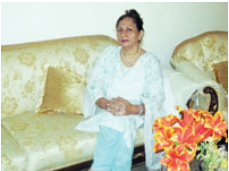
The woman of today is completely different from the one hailing from our mother's and grandmother's time. She has emerged as an educated, independent woman, who is ready to share the burden of earning a living with her significant other.
It is this new woman that Mrs Khan, a matchmaker by profession, deliberates on while talking to Kolachi. Running a marriage bureau for the last 12 years, Mrs Khan has arranged several successful matches.
Kolachi: What qualities do men look for in their life partners?
Mrs Khan: Trends have certainly changed as far as looking for an ideal life partner is concerned. Men today want wives who are equally educated and are willing to work outside the house.
Kolachi: How have men's attitudes changed towards working women?
Mrs Khan: For many years, men thought it was insulting to have their wives work alongside them. Their families did not approve of such girls. Now, however, given the increase in the cost of living, men want women who work and can support the family along with them. In the last two years, men's attitudes towards educated and working women have greatly changed.
Kolachi: How educated does a man want his wife to be?
Mrs Khan: Gone are the days when men wanted an 'Inter or BA pass' companion. There are some conservative families who still think that an educated woman may start controlling their son but most of them don't think that way anymore. Families come to me seeking girls who have a Master's degree from reputable universities. Men want doctors and MBAs as their wives now.
Kolachi: So have the other demands gone down?
Mrs Khan: Certainly not. The materialistic demands of men and their families have increased more and more with the passage of time. If a family is looking for an educated woman, then they also want the girl to be rich.
Also, families living in the upscale areas of the city are not willing to get their sons married off to girls living on the other side of the bridge as they believe that living standards differ from one area to the other. Previously, girls from North Karachi would get married to men living in Defence or Clifton but that doesn't happen anymore. Secondly, they want the girl and her family to be well-mannered, elegant and pleasing to the eye. Often families are rejected because of the way in which the tea was served to them. They scrutinise each and every thing -- from the house to the business and to the dowry prospects. Thirdly, people still prefer fair, petite girls and ask for them when they come to me.
Kolachi: So what does a woman want in a man?
Mrs Khan: The women of today are also extremely demanding. They want to get married to guys who are earning over Rs40,000 and are educated. A large majority wants young men who make a lot of money and has a high standard of living.
Kolachi: What is, in your opinion, the reason for the increase in divorces in Pakistan?
Mrs Khan: Given the lack of compromise from both parties, the divorce rate has become very high. In the last three to four years, the divorce rate in our country is the same as it is in western countries. Nowadays, the husband and wife are not at all patient with each other. I get many cases in which marriages have been broken within two to three months because the girl or the boy weren't able to live with one another. For this reason solely, I encourage families to meet and let their children decide whether or not they can get into a relationship.
The News on Sunday July 12, 2009
========================
Interview with Dr Fazeela Abbasi

'I firmly believe that if you are true to your word, you have got to show it with action. Instead of masquerading as champions and doing nothing but delivering eloquent sermons, one should roll up the sleeves and get to work'
'The present political norms these days are that politicians have little in common with the public. In our country at the moment, politics is about watching only one's own interest, making quick money and not hesitating to plummet to great depths of depravity'
Ibrar Sakhawat interviewed Dr Fazeela Abbasi, an adviser for the Health Ministry and the brand ambassador of ANTEIS
IS: Running a private clinic, social work, a post in the Health Department…how do you cope with such a hectic schedule?
FA: Practicing medicine has always been a heart compelled passion and when its heart driven, you never get exhausted in harnessing even your utmost energy to it. It in fact becomes a source of invigoration and inspiration, giving the dauntless determination to do even what is perceived impossible and to dwarf all the crises.
Social work is more of a genetic trait that got ignited by the decaying surroundings and compelled me to take it as a challenge. I firmly believe that if you are true to your word, you have got to show it with action. Instead of masquerading as champions and doing nothing but delivering eloquent sermons, one should roll up the sleeves and get to work.
I feel this is crucial especially at this very time when our country is trying to recuperate from an ailing economy, extremism, militancy and the judicial crisis. Pakistan is pretty dysfunctional and perilously close to becoming a failed state.
Keeping this very fact in mind, with great reservation and reluctance, I decided to work as an adviser for the Ministry of Health. I could envisage my social welfare role in a more holistic way, helping to trickle down the effect to masses more efficiently and giving an inordinate reach to people at large.
I could give an enormous push to the socio-economic uplift of the country by helping to chalk out a comprehensive health strategy.
Shuffling between these works does make the schedule pretty hectic at times but most of the time it is not because of the nature of work, it is because of my nature of being a professional and the relentless urge for perfection in every little detail of my work.
I remember the late Benazir Bhutto delivering a statement that spoke volumes. She said it matters not how you die, but how you live.
IS: You aim to serve humanity through medicine. Was this your childhood passion? What spurred you on towards this direction?
FA: Practicing medicine was a childhood passion, not a personal choice initially. It was a handed over task of translating my mother’s dream into reality. I was and still am fond of devouring books. Read beyond my years and peers. Even today my thirst for knowledge is unquenchable.
I was the top of the class throughout my academic career, securing 1st position in the pre-medical Fsc exams by breaking all previous records. I got various gold medals and distinctions at medical school. I completed residency from Saint Johns Institute, London with flying colours. A doctorate in medicine is another academic endeavour that I have achieved.
IS: You have spent a great deal of time volunteering for various causes. What gives you the motivation for this?
FA: A life lived only for one’s own self is a life not worth living.
IS: Why did you choose dermatology in the field of medicine? Any specific reason? The concept of looking good…what is your take on it?
FA: During my fourth year at medical school, we began to do rotations and research in several different disciplines. I did a dermatology rotation early on and enjoyed the procedures. At that point, I started researching my options and realised that dermatology might be an excellent field to specialise in. I did enjoy many other fields but I just felt dermatology was the best fit for me.
Appreciation of beauty and to look good is an inherent human trait. There is nothing wrong in pursuing the desire to look scrumptious. It is okay to explore the frontiers of vanity with fearlessness.
The creation of the human soul and orchestration of its genetic makeup has in itself beauty of its kind, reflecting the creator’s love for pristine beauty.
I am blessed to practice what is my passion and I am able to display my artistic temperament wrapped in a creative cocoon. Aging is an inevitable process but aging gracefully is what I emphasise on.
IS: Besides dermatology, you also specialise in the field of venerology. So you have any particular aim in this direction?
FA: Well to be very honest I do not see myself doing a lot in this field, as I do not cater to male patients and the majority of the cases for the prevention or treatment of STD’s come from the male group. You have got to interact with both partners for effectively treating patients in this field and that is certainly not possible. In my capacity as an adviser, I do play an active role in devising tangible policy frameworks for the control of venereal diseases.
IS: You want to bring revolutionary changes in the health system. How do you intend to do that?
FA: As I said I am a professional down the core. Had I been given enough power, I would have made an effort to revamp the health system. But at the moment, this seems far from reality because of the limited authority I am allowed to exercise within my present portfolio. But I am trying to bring at least some change if not a lot.
I held discussions with the national programme managers of all the vertical programmes, to understand the programmes’ functioning, transparency issues, monitoring and surveillance. It is important for strengthening the health system, modifying the system or revamping it as a whole.
I went to Chakwal to visit the rural health centre and the female health worker’s house, which is a hub for local health activities. I had a great chance to mingle with these ladies who I learnt are our soldiers! An army of 100,000 soldiers equipped with the power to help trickle down the effects of the national health policy and all vertical programmes to the general population. They do it with an approach of pragmatism, which fascinated me.
I kept thinking about the late Benazir Bhutto who envisaged this programme. This programme has been a monumental initiative, well ahead of its time as there was hardly any interest or support for such endeavors in the mid-nineties.
However, with the strong political support that the late Benazir Bhutto enjoyed and her firm belief in the power of women and community ownership, the programme has persevered. Despite all constraints and challenges, the programme has proved its worth and now it is considered a flagship programme at the global front.
I also had an opportunity to talk on various policy-making issues with the national coordinators as well as the national trainers. I assured them of timely made decisions, which would be followed by solutions for the primary health system at national level.
IS: You are the representative and the brand ambassador in the Middle East and Asia for the Swiss fillers, ANTEIS. It must have been a proud moment. How did you feel?
FA: I was very happy. It was not sudden news. I was told that my name was being considered for the brand ambassadorship, but it will be finalised after gauging my performance at national and international conferences of dermatology and cosmetic surgery. I am the first doctor in the Southeast Asia to be selected for this prestigious post for the most reputed international brand of ANTEIS.
IS: You have done exceptionally well and achieved so much at an early age. Where do you see yourself heading from this stage onwards in life? Is politics an option?
FA: In future, I want to be at the top of my profession and play my part to the fullest in the betterment of the people of Pakistan.
The present political norms these days are that politicians have little in common with the public. In our country at the moment, politics is about watching only one’s own interest, making quick money and not hesitating to plummet to great depths of depravity.
In contrast to this, I have a lot in common with the average Pakistani and I would definitely not be playing duping tricks with 180 million Pakistanis who would not be fooled by the impotent promises of political leader anymore, as they are bone tired of the endless twists, turns, pirouettes and bare faced lies.
If I will be allowed to survive in this system with my honour, grit and integrity and I see myself playing a positive role without duping my people, I would definitely give a shot in offing.
IS: Thank you so much for your time.
FA: You are welcome. *
Daily Times:Sunday, July 12, 2009
|
